
Why evidence is the hard part
Many organizations have AI policies. Far fewer can demonstrate that those policies were followed for a specific system on a specific date. Regulators, customers and certification bodies increasingly ask for the latter. The gap between 'we have a policy' and 'here is the approval record for this deployment' is where most AI governance programs quietly fail.
The reason is structural. Policies are written once, centrally, by people whose job is writing them. Evidence is produced continuously, at the edges, by people whose job is something else. Unless the program is designed so that doing the work produces the proof, evidence collection becomes a separate, unrewarded task—and separate, unrewarded tasks do not survive contact with a busy quarter.
The cost of the gap is rising. Customer due-diligence questionnaires now ask for AI governance artifacts. Regulators expect records. Certification against ISO/IEC 42001 is, at its core, an evidence exercise. Organizations that treat evidence as an afterthought end up reconstructing it under pressure, at ten times the cost and a fraction of the credibility.
What good evidence looks like
Strong evidence is specific, dated, attributable to a person or system, and linked to the control it supports. 'The team reviewed the model' is not evidence. A dated assessment document, completed by a named reviewer, recording specific findings and a decision, linked to the system and control it supports—that is evidence.
Notice that most of these artifacts already exist somewhere in the organization. The problem is rarely that the work was not done; it is that the proof was not captured, or was captured in a form—an email thread, a chat message, a verbal sign-off—that cannot be produced, attributed or relied upon later.
- Signed approval records for high-risk deployments
- Impact and risk assessment documents
- Model testing and validation results
- Training completion records
- Monitoring reports and incident logs
- Meeting minutes from governance committee reviews
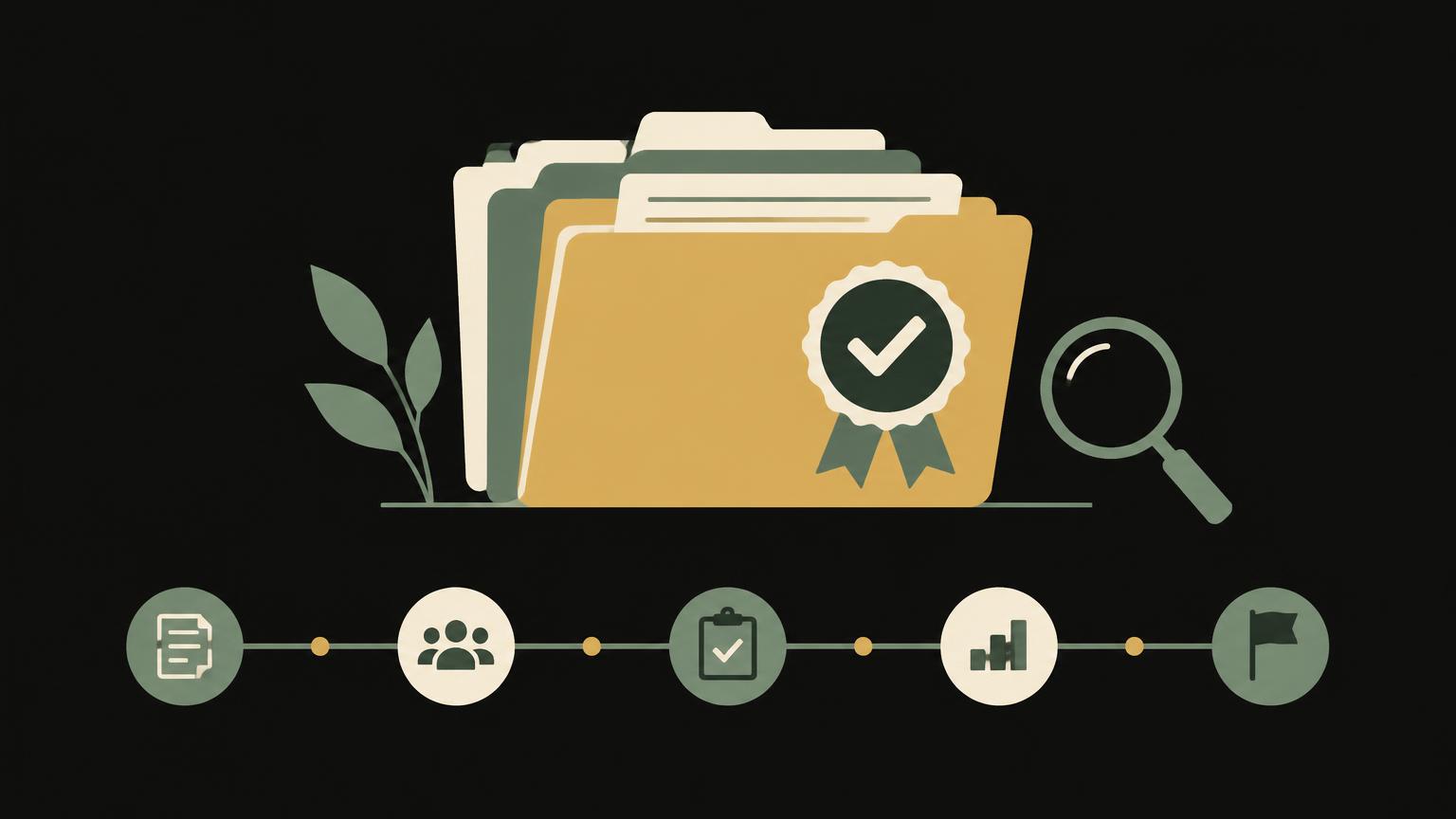
- 01ControlDefined requirement and owner
- 02ActivityThe work actually performed
- 03EvidenceDated, attributable artifact
- 04ReviewVerified and kept current
Design controls with evidence in mind
For every control, write down what proof will demonstrate it is operating, who produces it and how often. If you can't describe the evidence, the control is probably too vague to operate. 'Systems are monitored' fails this test. 'The system owner reviews the monthly drift report and records the review in the platform' passes it—and, not coincidentally, is also much easier for the owner to actually do.
This discipline improves the controls themselves. Forcing the evidence question exposes controls that sound good but mean nothing, and it right-sizes the ones that remain. A control library where every control has a defined artifact, owner and cadence is shorter, sharper and dramatically more credible than a longer one built on aspiration.
It also makes delegation possible. When evidence expectations are explicit, control operation can be handed to system owners with confidence, and the governance team's role shifts from doing the work to verifying the proof—a much more scalable model.
Collect as you go
The most reliable evidence is generated automatically by workflows—approvals in a system rather than email, assessments completed in a tool, logs retained by default. This reduces the burden on teams and makes audits routine rather than disruptive. The design principle is simple: the path of least resistance should be the compliant path.
Where automation is not possible, make capture frictionless. A committee decision should produce minutes as a standing habit, not a special effort. A training session should record attendance as part of running it. Every manual step between doing the work and having the proof is a place where evidence will eventually be lost.
Resist the urge to over-collect. Evidence tied to a defined control is assurance; undifferentiated document hoarding is storage. The test for keeping an artifact is whether it answers a question an auditor, regulator or board would actually ask.
Keep it current
Evidence ages. A risk assessment from two years ago says little about the system as it runs today, and a training record for a departed employee proves nothing about the current team. Set review dates, flag expiring items and treat stale evidence as a finding—because that is exactly what an auditor will treat it as.
A dashboard showing evidence coverage and freshness gives leaders a real-time view of assurance posture: which controls have current proof, which are expiring, which have none. This turns audit readiness from an event into a steady state.
The payoff arrives at the moment of truth. When the customer questionnaire, the regulator's request or the certification audit lands, an evidence-driven program answers in days from material that already exists. That speed and calm is the visible signature of a governance program that actually operates—and it is worth every bit of the discipline that produced it.
Make your next audit a formality
We design controls around the evidence they should produce—so approvals, assessments and reviews generate proof as the work happens, not the week before the audit.