


The campus is already an AI ecosystem
A student uses a general-purpose assistant to understand a difficult reading. A professor experiments with feedback on draft essays. A research group tests a model against unpublished data. Enrollment staff consider a tool that predicts which applicants may need additional support. The procurement team renews a vendor contract, unaware that an AI feature was added last month. Each example raises a different question, but all are happening within the same institution.
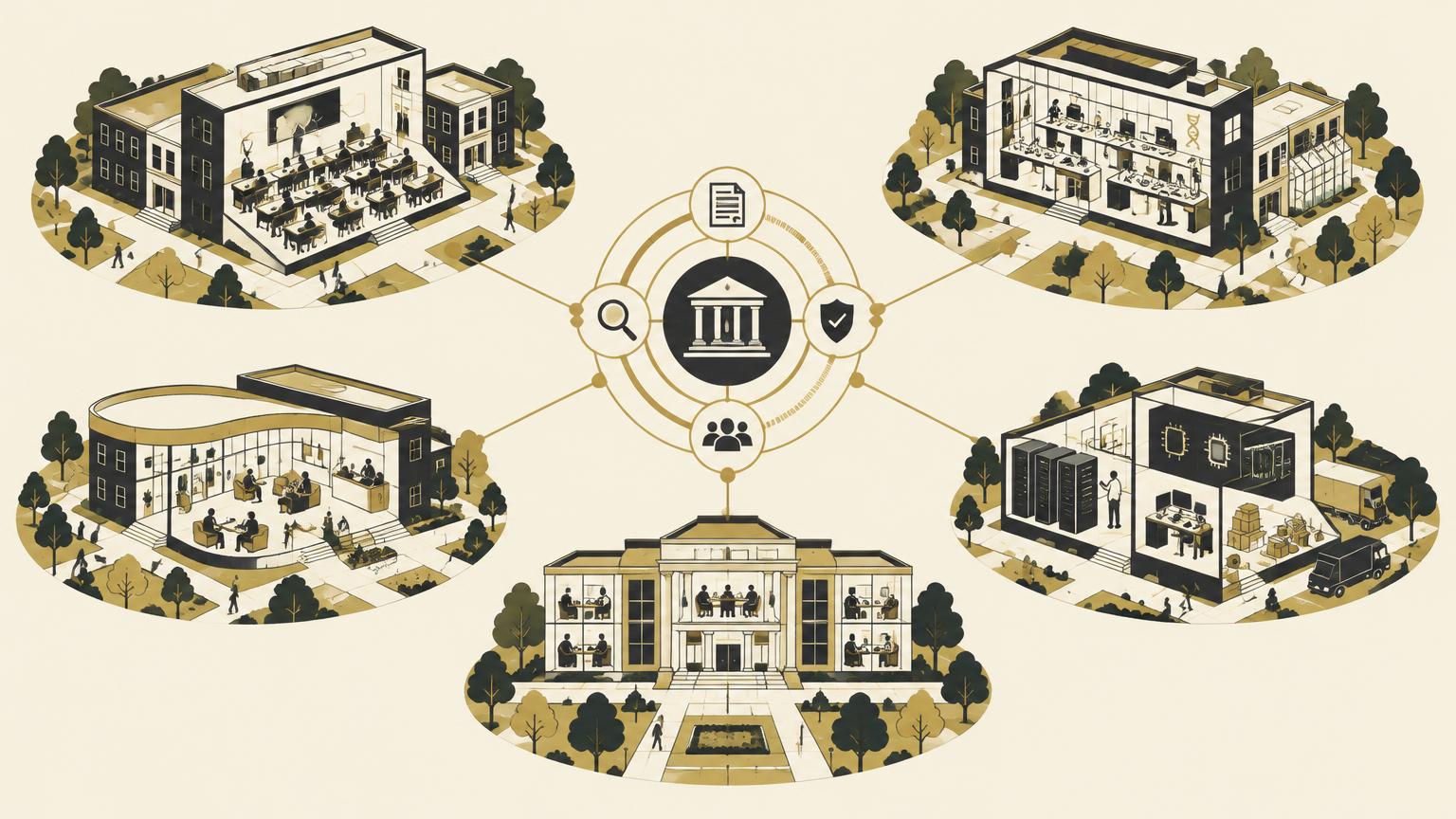
Higher education cannot govern AI effectively by issuing one blanket rule about chatbots. Colleges and universities are decentralized by design: departments control curricula, principal investigators lead research, administrative offices purchase systems, and students use tools of their own choosing. Academic freedom and experimentation are strengths, not obstacles to be erased. Yet a tool that handles education records, influences access to support or produces research claims creates responsibilities that extend beyond the person using it.
The central governance question is therefore not whether a campus should permit AI. It is how to know what is in use, understand its consequences and make decisions that the institution can explain. A workable program gives low-impact experimentation a clear path while reserving deeper scrutiny for uses that affect people, confidential information or the credibility of academic work. That is how responsible oversight can support, rather than suffocate, innovation.
Why the stakes are different in higher education
Universities serve multiple populations at once: prospective students, enrolled learners, faculty, staff, researchers, alumni and research participants. They also steward unusually varied information, from coursework and advising notes to personnel files, unpublished findings and sometimes health-related or grant-restricted data. One AI service can touch several of these categories in different contexts. A faculty member pasting a public article into a writing tool is not presenting the same risk as an adviser uploading identifiable student records.
Errors have distinctive consequences. An inaccurate study guide can be corrected; an unsupported risk score used to prioritize student outreach can shape someone's experience before they know a score exists. An automated response to a financial aid question may sound authoritative while getting an exception wrong. A fabricated citation in a research draft can undermine a paper if no one checks it. Accessibility failures or language disparities can compound disadvantage precisely where an institution intends to widen opportunity.
- 01DiscoverFind use cases across the institution
- 02AssessReview impact, data and ownership
- 03DecideApprove with appropriate safeguards
- 04RevisitMonitor, document and improve
Start with a shared definition of the work
Before writing a lengthy policy, define what counts as an AI use for institutional oversight. Include stand-alone assistants, AI embedded in learning-management or office systems, tools built by campus teams, research applications and vendor systems used on the institution's behalf. A single product may need multiple inventory records when it serves meaningfully different purposes: summarizing public meeting notes and advising a student using protected information should not inherit the same risk decision.
Then define the boundary between institutional use and personal experimentation. An institution cannot realistically catalog every private student query. It can set rules for university-provided tools, institutional data, official decisions and research conducted under its authority. Explain those boundaries plainly. If a course allows students to use external tools, the instructor can specify disclosure expectations and alternatives without pretending the central office can monitor every prompt.
Assign a small cross-functional group to establish the vocabulary: the provost's office, academic affairs, IT, information security, privacy, research administration, student affairs, accessibility, procurement and faculty representatives. Student perspectives should inform uses that shape student experience. The group does not need to approve every experiment. It needs to agree on what triggers review, who owns a decision and when a matter escalates. Its first useful output may be a two-page intake guide rather than a hundred-page policy.
Build an inventory that reflects how a campus actually buys and uses AI
An inventory is a living record of use cases, not a static directory of approved brands. For each institutional use, record its purpose, unit, accountable owner, users and people affected, data categories, vendor, whether AI output informs a decision, and deployment status. Add a review date and a link to the assessment or approval. This modest set of fields makes a record useful to a dean, privacy officer and security reviewer alike.
Discovery should combine several channels. Ask colleges and offices what they are already using; review procurement and contract renewals; examine centrally managed application catalogs; and ask IT teams where new AI features have appeared inside familiar systems. Invite faculty and staff to disclose use without presuming wrongdoing. A purchasing record may reveal a tool but not how it is used. An access log may reveal a connection but not the data entered or the educational consequence. Confirm context with the owner before assigning a risk level.
Classify use cases by impact—not by excitement or fear
A risk-tiering model makes oversight proportional. A low-impact use might be drafting a public event description with no confidential information: register it, give clear acceptable-use guidance and retain a human editor. A moderate-impact use might summarize internal planning documents: add data-handling and vendor review. A high-impact use might influence admissions, discipline, employment, access to services or other meaningful outcomes for people: require a documented assessment, appropriate testing, explicit approval, human oversight and a challenge or appeal path where warranted.
Ask a short series of concrete questions. Who is affected? Could the output change a person's opportunity or treatment? What records or intellectual property enter the tool? Is the result advisory, or will a decision maker routinely defer to it? Can an affected person understand and contest an error? How reversible is a mistake? The answers matter more than whether the technology is called generative AI, machine learning or automation.
Document uses the institution will not permit, such as entering restricted data into an unapproved consumer service or making a specified consequential decision solely from an unreviewed AI output. Those are examples for leadership to decide, not universal rules imposed by this article. A tier should determine the actual review path. If every tier faces the same committee and wait time, people will avoid the process; if no tier changes the safeguards, classification is merely decoration.
Protect student information without oversimplifying FERPA
The Family Educational Rights and Privacy Act, or FERPA, governs access to and disclosure of personally identifiable information from education records at covered institutions. It does not mean every classroom AI interaction is forbidden, nor does it mean a vendor's generic privacy page is enough. The Department of Education's student-privacy guidance advises educators to check whether an online service is approved and describes conditions for relying on the school-official exception. Institutions should have counsel and privacy staff evaluate the facts of each arrangement, including whether an exception applies and what agreements and controls are needed.
In practice, give campus users a simple data classification guide. Which approved tools may process public material? Which may receive internal documents? Which, if any, may handle student records or other restricted information under a reviewed agreement? Do not ask a professor to interpret a complex vendor contract at the point of use. Procurement, privacy and security teams should evaluate retention, access, onward sharing, model-training terms, subprocessors, deletion, security and incident notification before approving a sensitive workflow.
Data minimization is an equally important habit. Test a tool with de-identified or synthetic examples where appropriate; limit access to only the fields necessary; and make sure prompts, outputs and logs follow retention rules. Research participant information, health-related data and grant-restricted datasets may involve additional obligations beyond FERPA. Maintain separate applicability checks rather than labeling every campus data question a FERPA issue. The safe question is not 'Is this an AI tool?' but 'What information will this use disclose, to whom, under what authority and with what safeguards?'
Give teaching and learning room for judgment
Teaching is not a single workflow. One instructor might welcome AI as a brainstorming partner; another might prohibit it in an assessment designed to measure unaided reasoning. A central policy can establish baseline expectations around privacy, accessibility, disclosure and academic integrity while leaving course-level choices to faculty within institutional rules. Faculty participation in designing those guardrails is essential: rules written without the people doing the teaching are likely to be ignored or applied inconsistently.
The US Department of Education's report on AI and the future of teaching and learning emphasizes maintaining human judgment as AI systems support educational decisions. That principle becomes concrete when an instructor reviews feedback before it reaches a student, a student can ask why a recommendation was made, and a course team checks whether a tool performs comparably across the learners it serves. The goal is not to ban assistance. It is to preserve the educational relationship and the integrity of evaluation.
Treat research as a distinct governance lane
Research teams may use AI to code, analyze images, explore literature or draft language. Their risks differ from student advising or office productivity. A model can invent citations, distort a summary or silently transform a dataset. A third-party service may retain unpublished material or receive information governed by consent terms, sponsor requirements or a data-use agreement. Review must account for the research context rather than treating every laboratory as a generic administrative user.
Give investigators an intake path that connects, rather than duplicates, existing structures. Research administration, the library, information security and, where applicable, human-subjects review teams can help determine whether a proposed tool is compatible with data permissions and scholarly standards. Ask who will validate generated outputs, what methods and versions must be documented, whether collaborators and journals require disclosure, and where restricted datasets can be processed. The principal investigator remains accountable for the integrity of work produced under the project.
Avoid claiming a single institution-wide rule settles every publication question. Publishers, funders and disciplines have different disclosure and authorship requirements. A useful campus guideline directs researchers to those applicable rules, sets minimum expectations for verification and data handling, and offers a rapid escalation path when a tool's terms conflict with project obligations. The same principle extends to peer review and grant evaluation, where confidential submissions must not be casually entered into external systems.
Evaluate vendors beyond the sales demonstration
Much of a campus AI portfolio will be purchased rather than developed in-house. A learning platform may introduce automated feedback; a student-success provider may add predictive scoring; a productivity suite may turn on an assistant. Procurement should ask vendors which features use AI, whether those features can be disabled, what institutional information they receive, whether that information trains or improves models, and what happens when the underlying model changes.
Match diligence to the use. A public-content drafting tool might need a short security check and an approved-use note. A system that ranks students for support needs a much fuller review of performance, limitations, accessibility, data provenance, oversight and potential disparate effects. Ask for relevant evidence, not simply promises. When a vendor will not share enough information to evaluate a consequential use, record the uncertainty and decide whether the institution can accept it; do not quietly translate 'proprietary' into 'safe.'
Turn principles into controls and evidence
The NIST AI Risk Management Framework offers a useful organizing structure: Govern, Map, Measure and Manage. Govern addresses roles and policies; Map describes the system and its context; Measure asks how risks and performance are examined; Manage turns findings into actions and ongoing decisions. NIST's Generative AI Profile adds considerations for risks such as confabulation and privacy. Both are voluntary resources to adapt, not a certificate or a substitute for institution-specific legal review.
Translate each principle into an observable practice. 'Human oversight' means naming the person who reviews an output, giving them authority to reject it, specifying when review happens and recording the decision. 'Vendor review' means documenting the assessed feature, terms, gaps and approving owner. 'Monitoring' means assigning a cadence and defining what signal triggers a pause or reassessment. A dashboard cannot repair an undefined responsibility; it can make a defined responsibility visible.
For each significant control, decide what evidence will show it operated: a dated assessment, approval with conditions, vendor response, test result, training record, incident report or periodic owner confirmation. Keep evidence linked to the relevant use case and review it for freshness. A policy file stored in a shared drive is not proof that a particular admissions tool was assessed before deployment. The record of that decision, who made it and what they reviewed is the useful artifact.
A realistic first 90 days
During days 1 through 30, name an accountable sponsor and convene a small working group with faculty and student input. Publish interim guidance on approved tools and restricted data. Open a short intake form and assemble a first inventory from procurement, IT and voluntary disclosures. Prioritize a handful of uses that affect student outcomes or handle sensitive records. The first objective is visibility and a trusted reporting channel, not a complete census of every AI experiment.
During days 31 through 60, adopt risk tiers and an approval path with clear owners and target response times. Run real assessments for the priority use cases. Test the path with an instructor's proposed teaching tool, a research use involving restricted data and a student-services vendor feature. Each case will reveal a different missing question. Refine the intake accordingly, and document where the institution needs legal interpretation rather than letting a committee guess at it.
During days 61 through 90, connect the process to procurement, contract renewal and material-change review. Assign recertification dates, define the minimum evidence for each tier and provide short training tailored to faculty, researchers and administrators. Produce an initial leadership report: inventory coverage, uses awaiting review, high-impact approvals, open gaps and overdue decisions. Ask the early users where review was unnecessarily slow. Fix the path before scaling it campus-wide. Ninety days should produce a functioning loop, not a declaration that governance is finished.
Measure whether the program works for people
Count what helps leaders intervene. How many identified institutional AI uses have named owners? What share of higher-impact uses have current assessments and documented decisions? How long does intake take by risk tier? Which vendor features changed after initial approval? How many findings remain open beyond their target dates? These measures expose coverage, timeliness and accountability. Report definitions and known blind spots alongside the numbers so a rising count of AI systems is not mistaken for a rising rate of harm.
Qualitative feedback matters just as much. Are faculty confident they can seek advice without surrendering course-level judgment? Do students know when an automated recommendation influences a consequential service and how to reach a human? Can research teams get timely answers about a dataset? If the program is technically documented but routinely bypassed, it is not functioning. Surveys and short interviews can reveal why people avoid intake long before a dashboard does.
The long-term aim is a campus where beneficial AI is easier to use well and harder to use carelessly. That requires a dependable inventory, proportionate decisions, faculty and student participation, thoughtful vendor scrutiny and evidence that safeguards operate over time. Technology can organize the work; it cannot replace academic judgment, legal analysis or institutional accountability. Higher education's opportunity is not to choose between innovation and oversight. It is to build an operating practice that makes both possible.
Sources & further reading
Regulatory requirements depend on the facts and may change. Consult counsel for applicability to your organization.
- US Department of Education: Artificial Intelligence and the Future of Teaching and Learning
- US Department of Education: Online tools and FERPA guidance
- US Department of Education: Vendor FAQ on FERPA
- NIST: AI Risk Management Framework 1.0
- NIST: Generative AI Profile
- EDUCAUSE: 2024 AI Landscape Study
- AAUP: Artificial Intelligence and Academic Professions
Move from scattered AI use to accountable adoption
Explore how GovernIQX can help organize your institution's AI inventory, assessments, controls and leadership reporting—while your people remain responsible for the decisions.